

Dear investors,
My new portfolios for 2026 are now available and I would like to remind you that copying Warren Buffett’s trades, even with a 45-day delay, would have yielded impressive annual returns of 24.5% from 1976 to 2006, surpassing the S&P 500’s modest 13.83% return during the same period.
Copying the world’s most successful investors is the most effective strategy that most investors overlook. Monish Pabrai successfully built an $800 million fund using this very approach!
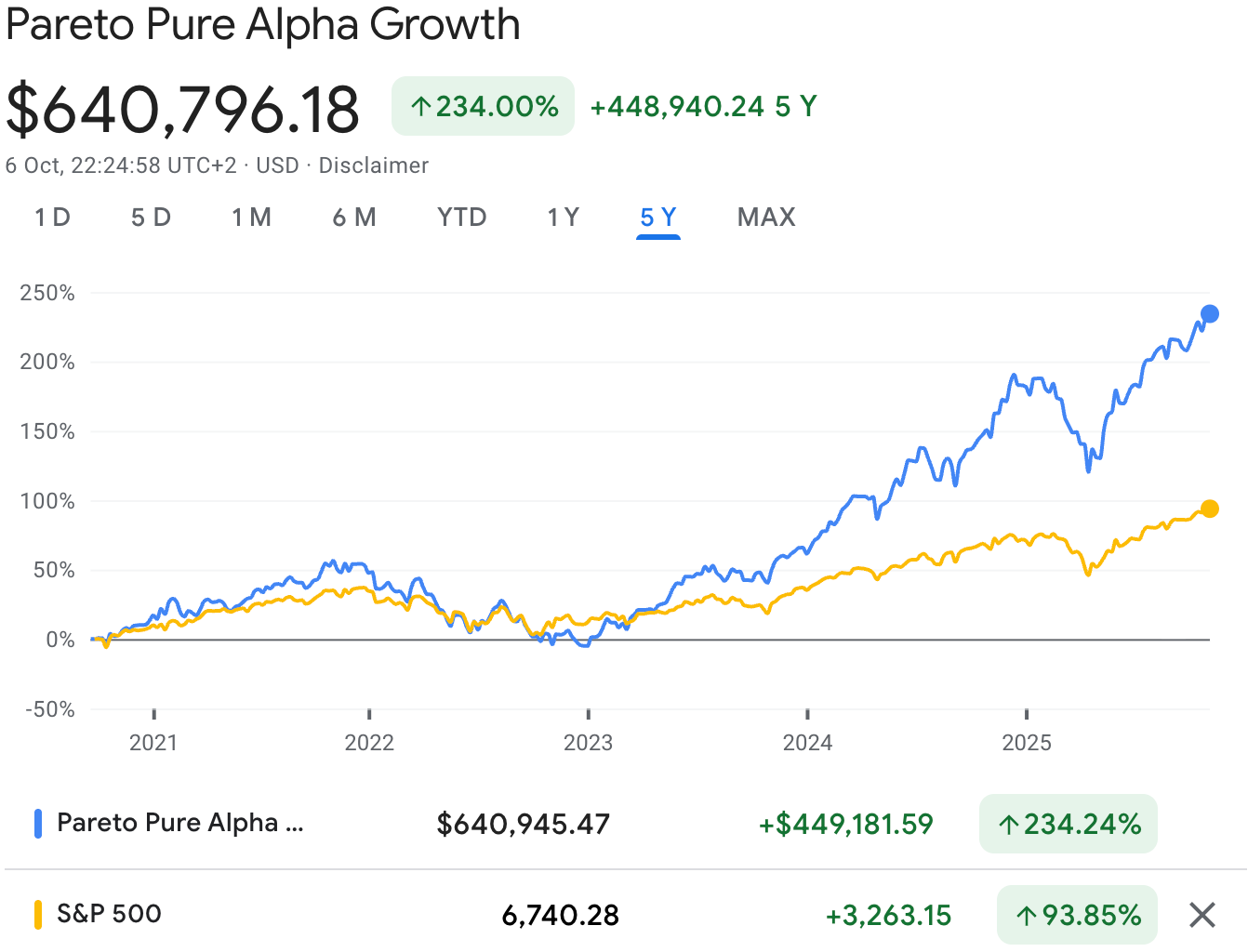
Today, I’ll demonstrate how to replicate my Pareto Portfolio in just minutes—the same portfolio that achieved an impressive +234% return over five years, surpassing the S&P 500’s modest +93% return.
Why Copying Works
Monish Pabrai, CEO of Dhandho Funds and a legendary value investor with approximately $800 million in assets under management, is a strong advocate of this strategy.
Monish, who won a bid of $650,000 for Warren Buffett’s annual charity lunch, has always idolized both Warren Buffett and Charlie Munger.
In fact, he has bronze busts of both investors prominently displayed in his office.
Monish’s friendship with Charlie Munger, which included sharing meals and playing bridge while discussing the world of investing, significantly shaped his approach.
One particular piece of advice from Charlie Munger stood out:
“Take a simple idea and take it seriously.”
This advice, combined with Munger’s deep understanding of human psychology and behavior in financial markets, became a cornerstone of Monish’s investing philosophy.
Humans have an aversion to copying, often considering it beneath themselves.
However, in the business world, copying successful strategies can lead to tremendous success.
Companies like Microsoft, Meta, and Amazon have all adopted copying as a strategy, and it has been a big part of their success stories.
For example, Microsoft’s success with products like Excel, Word, and Windows can be attributed to copying ideas from Lotus, WordPerfect, and the Mac, respectively.
Similarly, Amazon’s Prime service is a copying of Costco’s model, and their streaming service is modeled after Netflix.
Buffett, Munger & Pabrai About Copying
The idea of copying, or copying, might initially seem wrong, immoral, or even illegal.
However, in the context of investing, copying can be an absolute superpower.
The key is to understand that copying isn’t about plagiarism; it’s about learning from the best and adapting their strategies to your own investing approach.
Monish’s strategy involves studying the world’s top investors and shamelessly copying their approaches.
This isn’t about blindly following their stock picks but rather about understanding the principles and strategies that make them successful.
By doing so, you can gain a significant edge in the market.
A study found that if you simply copied Warren Buffett’s trades, even after the 45-day delay between the end of the quarter and the release of the 13F filings, you would have achieved an average annual return of 24.5% from 1976 to 2006, compared to 13.83% for the S&P 500.
Copying the strategies of the world’s best investors can provide a significant competitive advantage.
By studying their approaches, understanding their principles, and making their ideas your own, you can achieve remarkable success in the world of investing.
However, blindly following someone else’s stock picks without understanding the underlying reasons can lead to poor decisions.
Pareto Growth Portfolio: Consistently Outperforming
Over the past 5 years, my portfolio has demonstrated remarkable growth.
If you’re looking to challenge the status quo on index funds and seek superior returns through a simplified yet super effective investment strategy, this is it!
Whether you’re a beginner or a seasoned investor, my approach cuts through the noise and simplifies your path to financial success.
Investing doesn’t have to be overwhelming—clarity outperforms complexity.
Less is more. Precision beats diversification.
And amid countless strategies, I discovered that one stands above the rest.
The Pareto Principle!
By focusing on the few high-impact stocks that generate the majority of market returns, you can simplify your approach, amplify your results, and achieve financial success with less effort.
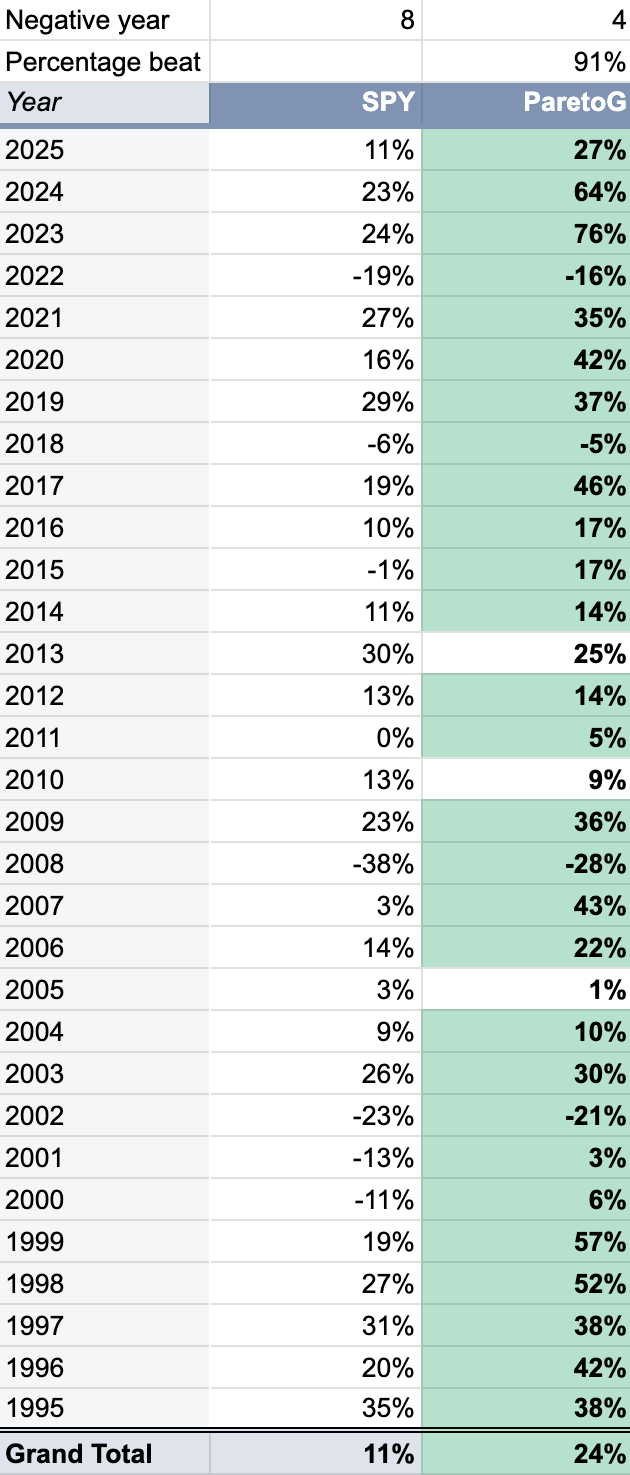
From its inception in 1997 (back testing), my Pareto strategy has not only yielded impressive returns but also provided invaluable insights that continue to guide my investments today.
Wealth Gap: Why This Matters Long-Term
Getting started takes less than 5 minutes. You don’t need complex financial models or hours of research—just quarterly alerts telling you exactly what I buy and sell, when I do it.
The implementation process prioritizes simplicity and replicability over complex analysis.
Watch how the wealth gap explodes over time. At 24% annual returns, your money doubles every 3.4 years. The S&P 500 at 11% takes 6.5 years—nearly twice as long.
A portfolio delivering 24% annual returns doubles approximately every 3.4 years, while an 11% portfolio requires 6.5 years to double.
An initial $10,000 investment in the S&P 500 delivering 11% annual returns would grow to approximately $228,000 over 30 years.
The same investment with a Pareto strategy delivering 24% annual returns would reach approximately $6,500,000, representing more than 8 times greater terminal wealth.
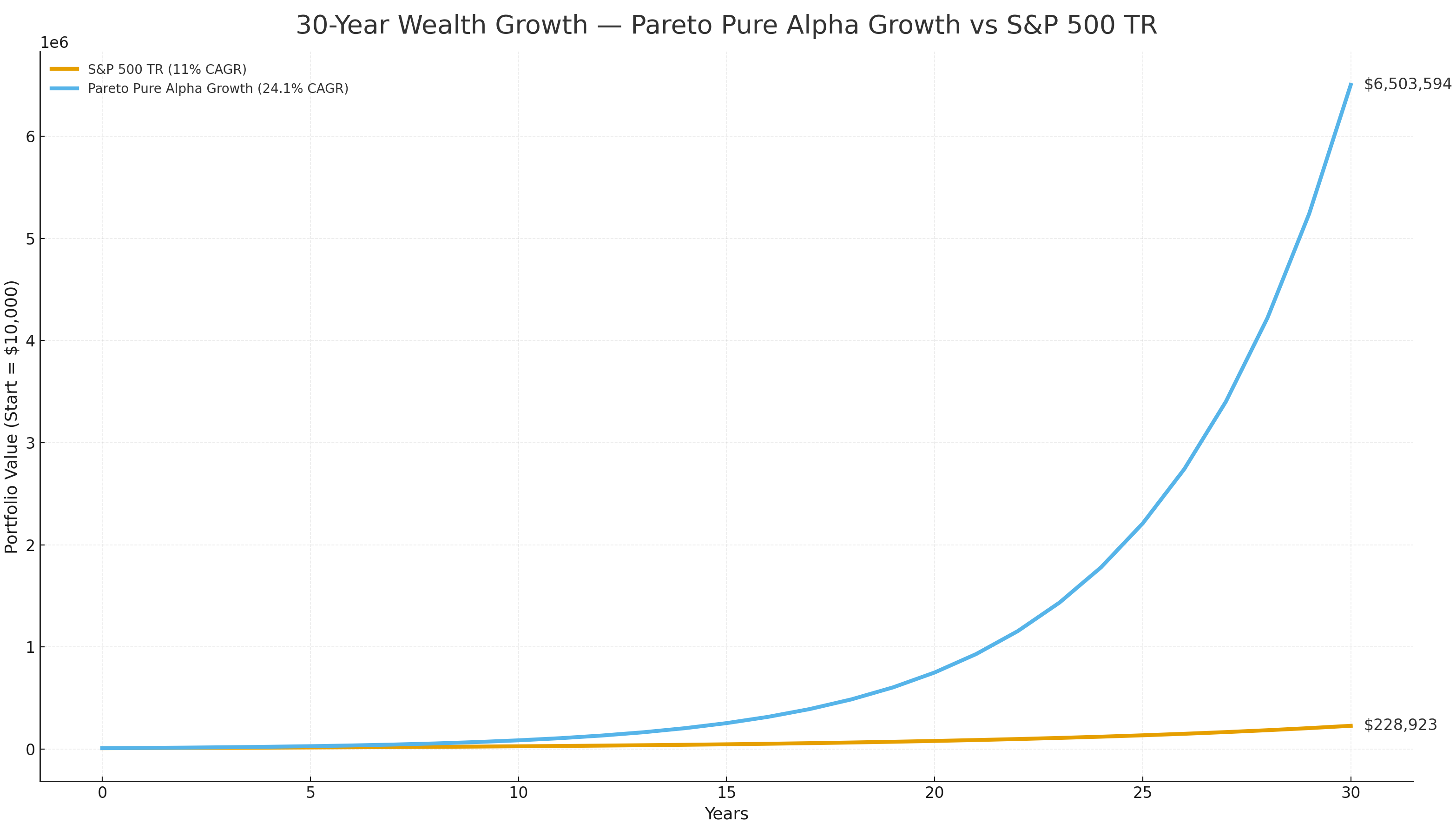
This extraordinary difference illustrates how seemingly modest percentage point advantages compound into life-changing wealth differentials over investment careers spanning decades.
For investors beginning accumulation in their 30s and continuing through retirement in their 60s, strategy selection becomes one of the most consequential financial decisions they will make.
Ready To Start Copying?
Why settle for average returns when you can maximize your portfolio’s performance, and make your money work smarter, today!
It’s worth noting, I have a total return of 234%—a market-crushing outperformance compared to the S&P 500’s 93% over the last 5 years.
Take your investments to the next level today!
Access All My Pareto Portfolios:
Growth: my core engine for long-term compounding
Dividend: my income portfolio of dividend compounders
Permanent: my 3-ETF all-weather portfolio for protecting & compounding capital
Subscribers’ Reviews 2026
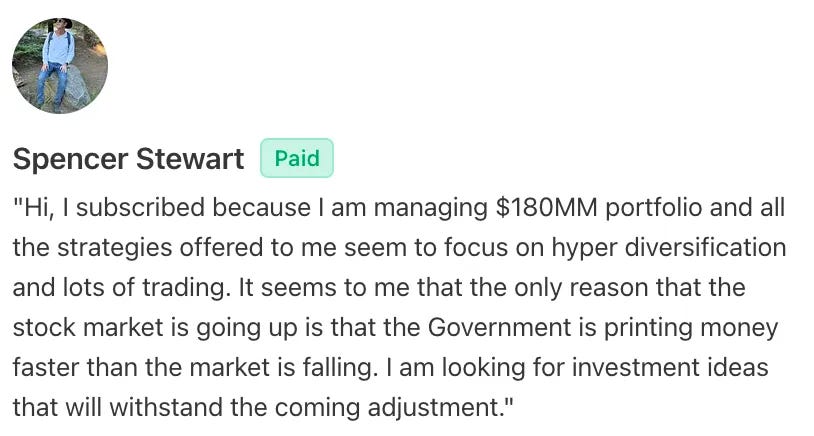
What 1000+ Paid Members Are Saying:






















Only 4% of stocks account for nearly all net wealth creation in the market.
Why settle for mediocre index returns held back by thousands of underperformers?
Join 1,000+ investors focusing only on the rare winners — and upgrade your returns with the Pareto Principle today!
Sincerely,
The Pareto Investor
Want to see my latest portfolios move? I often publish detailed portfolio updates showing how I apply 80/20 rule to real capital.
You are the best ! Love following your guidance here. As a 58 yo approaching retirement was looking for a hedge sleeve and using commodities as a way to do it. Got in with SLV at 62 and staring at 100 this morning. Thank you! Question for me is should I parlay the SLV into physical silver . I am not clear on the ramifications of the silver to paper asset gap and when and how could that break. Thanks!!
Hi there - I'm a new paid subscriber and thrilled to have access to your ongoing portfolios and updates! Your approach seems very well thought out and reasoned -- and well supported by excellent past returns.
I have two questions:
(1) I've tried searching but am not finding a post that gives an overview of tradeoffs of the different portfolio types you've put together (Growth, Dividend, Permanent, and Momentum). I understand that the Momentum is recommended to be limited to 10–25% of total investable capital from your FAQs on that page. I think part of me is trying to figure out whether we might want to try a mix of all 4 portfolios, or if that in itself is perhaps more diversification and complexity than necessary (given that the strategy is around targeted choices).
(2) Is there risk in any of the Pareto portfolios of not having exposure to international markets/companies? (I ask because an advisor we met with years ago had noted the importance of international + domestic variety, and also small- and mid- and large-cap variety.)
For context, in case it's helpful, my wife and I are in our 30s. We live in a high cost of living area, so while our combined income right now is around $200k, most of that is spent on our mortgage, home repair costs, and health insurance, without as much available for investing as we'd like. We don't have kids (but plan to in the coming years). We plan to retire in our 60s (at the latest), but are eager to have greater returns on retirement investments and overall investments.
Thanks so much!!