


Dear investors,
On December 5, 1791, a 34-year-old immigrant with no inheritance, no family name, and no formal country of origin climbed the steps of the U.S. Congress carrying a document under his arm.
His name was Alexander Hamilton.
He had arrived in New York as a penniless teenager from a small Caribbean island.
Fifteen years later he was George Washington’s right hand. He became the first Treasury Secretary in American history, and the document he carried — the Report on Manufactures — argued something that sounded almost heretical to a nation of four million farmers who imported nearly everything they owned from the empire they had just fought a war to escape.
A country that cannot make what it needs is not truly independent, no matter what its constitution says.
Hamilton’s prescription had two parts:
tax foreign goods at the border to make them more expensive,
and subsidize young domestic industries until they could compete on equal terms.
Protect the infant industry until it can fight as an adult. America ran that playbook for roughly a hundred and fifty years. A nation of farmers with almost no manufacturing became the largest industrial power on Earth.
Two hundred and thirty-five years later, on June 23, 2026, U.S. Treasury Secretary Scott Bessent published an op-ed in the Wall Street Journal under the headline “Hamilton Inspires Trump’s Economic Statecraft.”
Earlier this year, U.S. Trade Representative Jamieson Greer delivered nearly the identical message from the stage at Davos, in front of the world’s assembled financial elite. This is the official position of the United States government, published in the paper of record, signed by the man who controls the world’s reserve currency.
And if you know how to read it, it is the most important investment signal of the decade — and it points, unmistakably, at gold.
I’m going to walk you through the entire story: how the dollar system was built, why it’s straining now, what the world’s central banks are quietly doing about it, and the specific number — a genuinely audacious one — that a growing chorus of serious macro strategists thinks gold needs to reach for the math to work.
I’ll also tell you honestly where that number comes from, and where it’s speculative.
And at the end, I’ll lay out three portfolio approaches for positioning around it.
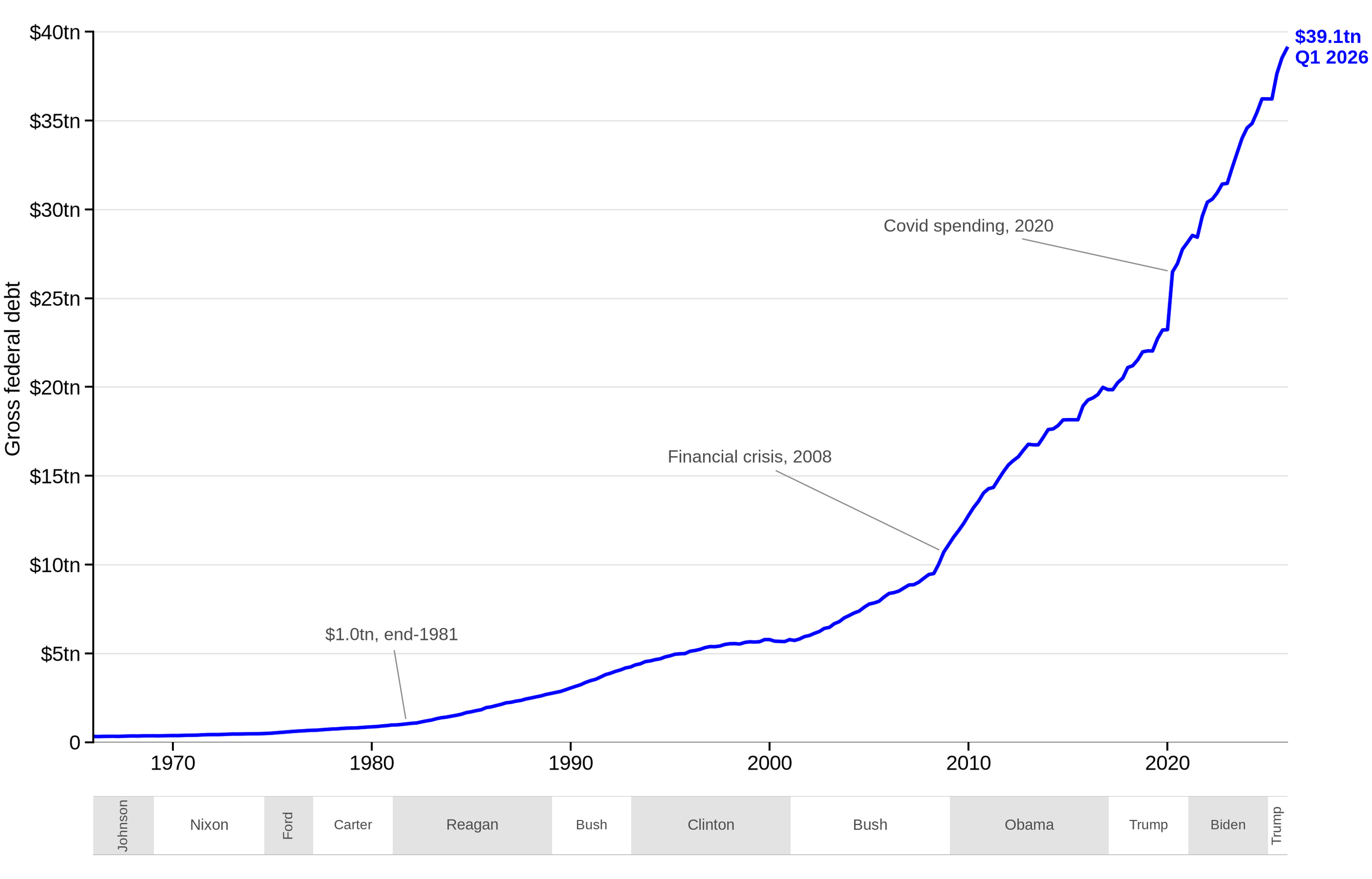
If you're worried about where all this debt leads, I explain it in detail in Treasury Collapse.
World’s Savings Account Is A Promise
Here’s a question almost nobody asks:
When a country sells more to the world than it buys, where does the surplus actually go?
Picture a baker who sells more bread than he buys flour. At the end of the month he has a surplus. China is, functionally, the world’s largest baker. It runs a trade surplus of roughly $1.2 trillion a year — close to one Pentagon budget.
That surplus has to be parked somewhere, and for eighty years the answer, for nearly every surplus country on Earth, has been the same: park it in dollars, specifically in U.S. Treasury bonds.
A Treasury bond is nothing more than an IOU signed by the U.S. government — lend your money, collect it back later with interest. Which means the world’s collective savings account, in practice, is a stack of American IOUs.
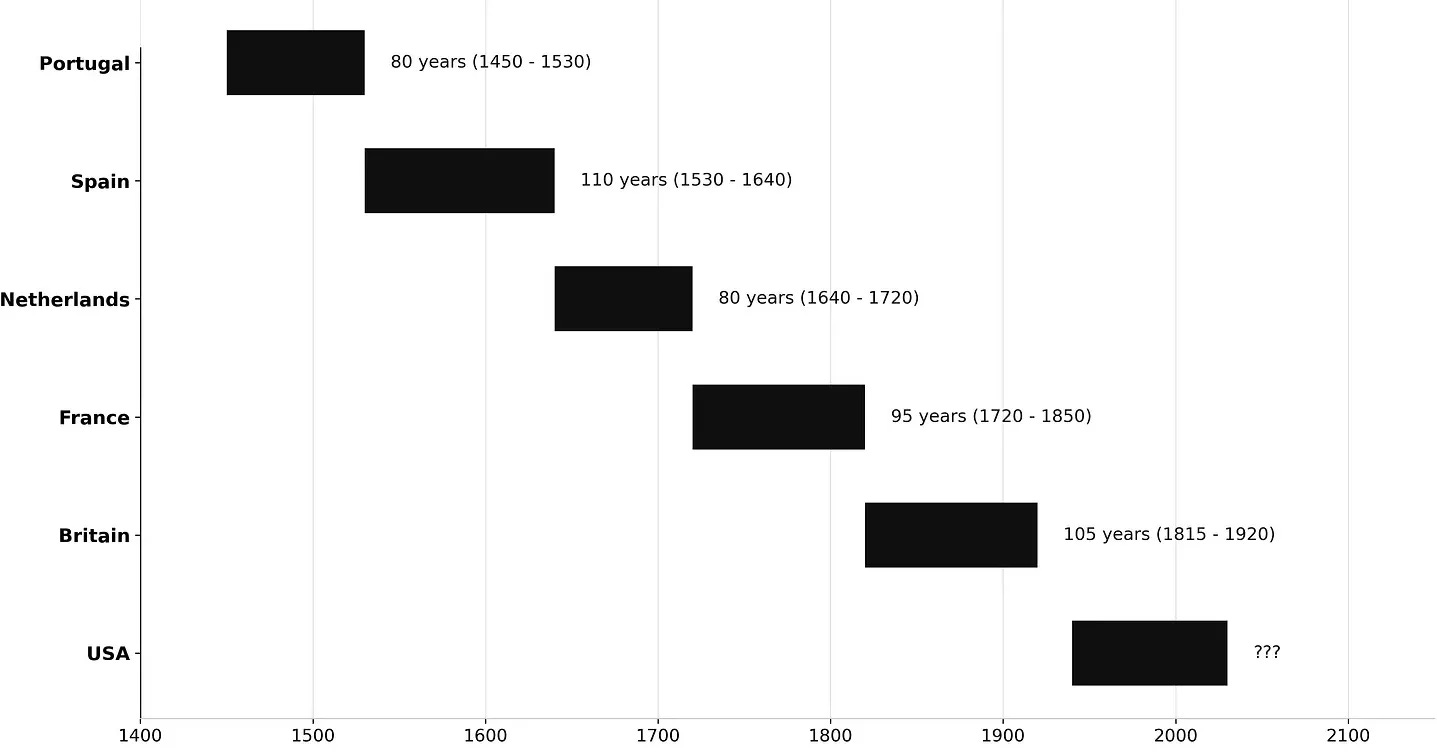
There is a structural flaw baked into that arrangement, and it isn’t subtle once you see it: the entity issuing the world’s savings vehicle can create as much of it as it wants, and every unit it creates quietly dilutes the savings of everyone else holding it.
Surplus countries stored their wealth in dollars. The country issuing those dollars can create more of them at will. That is not a savings account. That is a promise that can be diluted. China learned this lesson in the sharpest possible way in 2008 and 2009.
As Lehman Brothers collapsed and the Federal Reserve responded by creating money on a scale never before attempted in peacetime, Beijing — sitting on trillions of dollars of the very Treasury debt now being diluted — watched the country issuing its reserve currency demonstrate, in real time, exactly how freely that currency could be debased.
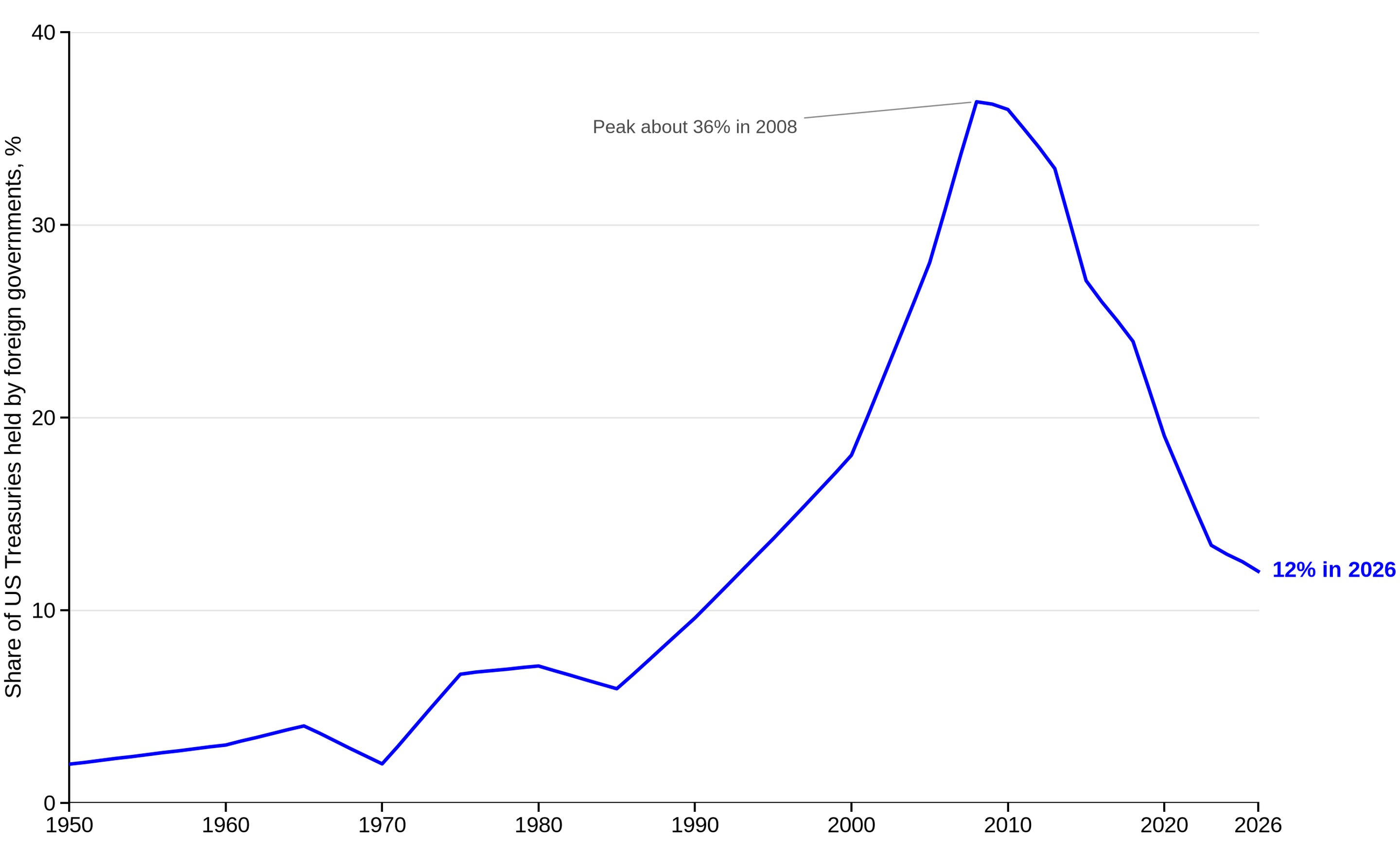
In March 2009, the governor of the People’s Bank of China, Zhou Xiaochuan, published an unusually direct essay arguing that the world’s reserve currency should ultimately be decoupled from any single nation and made stable over the long run — a savings account that belongs, in effect, to nobody and everybody.
It wasn’t a new idea. It was almost exactly the proposal John Maynard Keynes had made sixty-five years earlier.
Bancor & Bretton Woods—The Lost Idea
In 1944, at Bretton Woods, New Hampshire, the architects of the postwar monetary order gathered to decide how the world would settle its accounts once the guns fell silent.
Keynes arrived with a proposal for a neutral international currency he called the “bancor,” backed by a basket of commodities rather than any single nation’s promise.
Its elegance was that it punished imbalance automatically in both directions — a country running a chronic surplus faced a penalty just as one running a chronic deficit did, and the whole system self-corrected like a beam finding its balance point.
Under a genuine Keynesian bancor system, no single nation could hollow out another’s industrial base for decades on end.
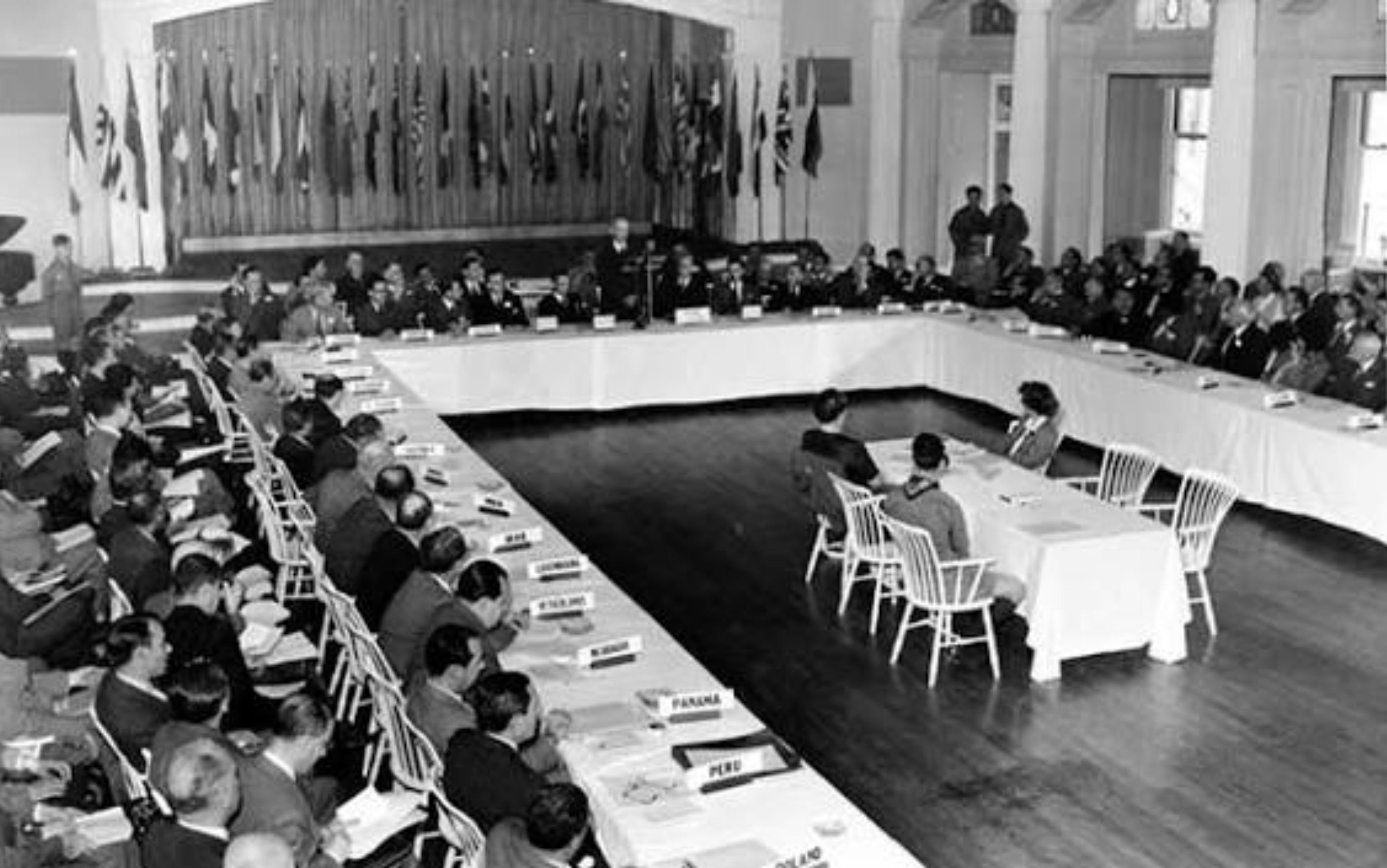
Keynes’s plan was rejected. The reason was simple: in 1944, the country running the largest trade surpluses in the world was the United States.
Washington had no interest in ratifying a system designed to punish exactly the position it occupied. The world inherited the dollar system instead — and inherited its missing piece, too.
That missing piece had a specific expiration date: August 15, 1971. That evening, President Richard Nixon addressed the American public and announced that the dollar would no longer be exchangeable for gold.
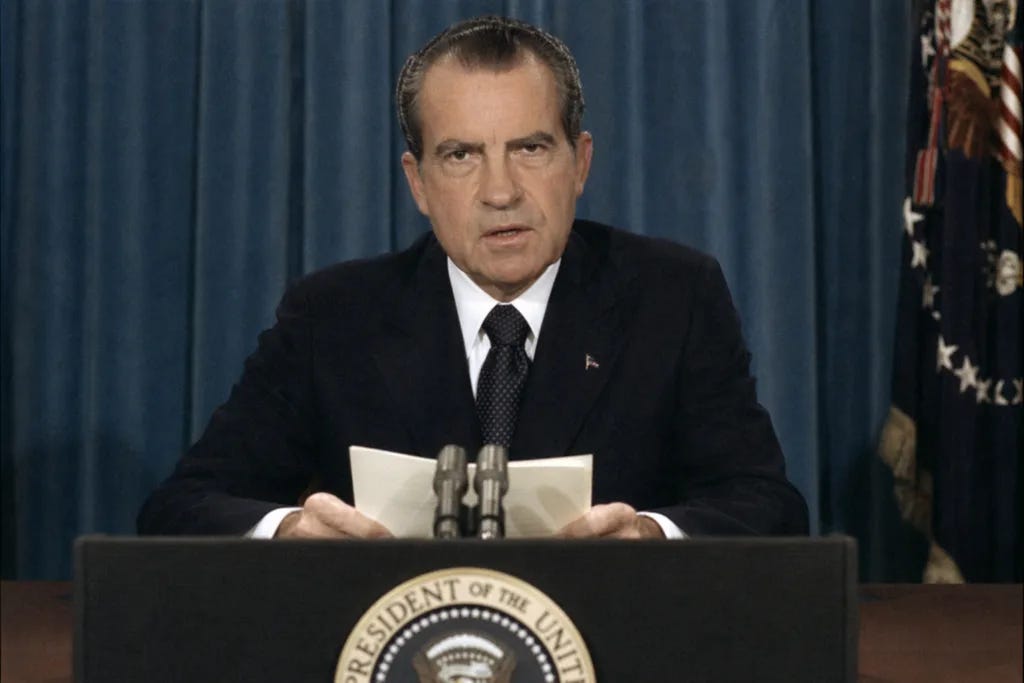
Until that moment, the dollar had carried at least a theoretical guardrail — every dollar was, in principle, backed by bullion sitting in a vault.
After that broadcast, the last cord tying paper money to something physical was severed, and the dollar has rested on exactly one foundation ever since: confidence.
Everything that has happened since — everything we’re about to walk through — is the long, slow aftershock of that single evening.
Asking for the Referee Back?
The request for a neutral arbiter didn’t end with Zhou Xiaochuan in 2009. It has resurfaced, from increasingly establishment voices, at regular intervals since.
In 2010, Robert Zoellick — then president of the World Bank, hardly a gold-bug fringe figure — wrote in the Financial Times that the world should consider using gold as an international reference point for currency values.
In 2016, Kenneth Rogoff, former chief economist of the IMF, advised emerging economies to convert a larger share of their reserves into gold, making a point worth sitting with: gold’s supply is essentially fixed, but unlike a fiat currency whose issuer can print without limit, gold’s price has no ceiling at all.
That distinction — fixed supply, unlimited price — is the entire mechanism behind everything that follows.
Empires Change Their Story Once They Win
There’s a second historical thread running underneath this one, and it’s just as important as the monetary story: what great powers do after they win.
Hamilton’s playbook — tariffs plus subsidies plus patient industrial buildout — is not unique to America.
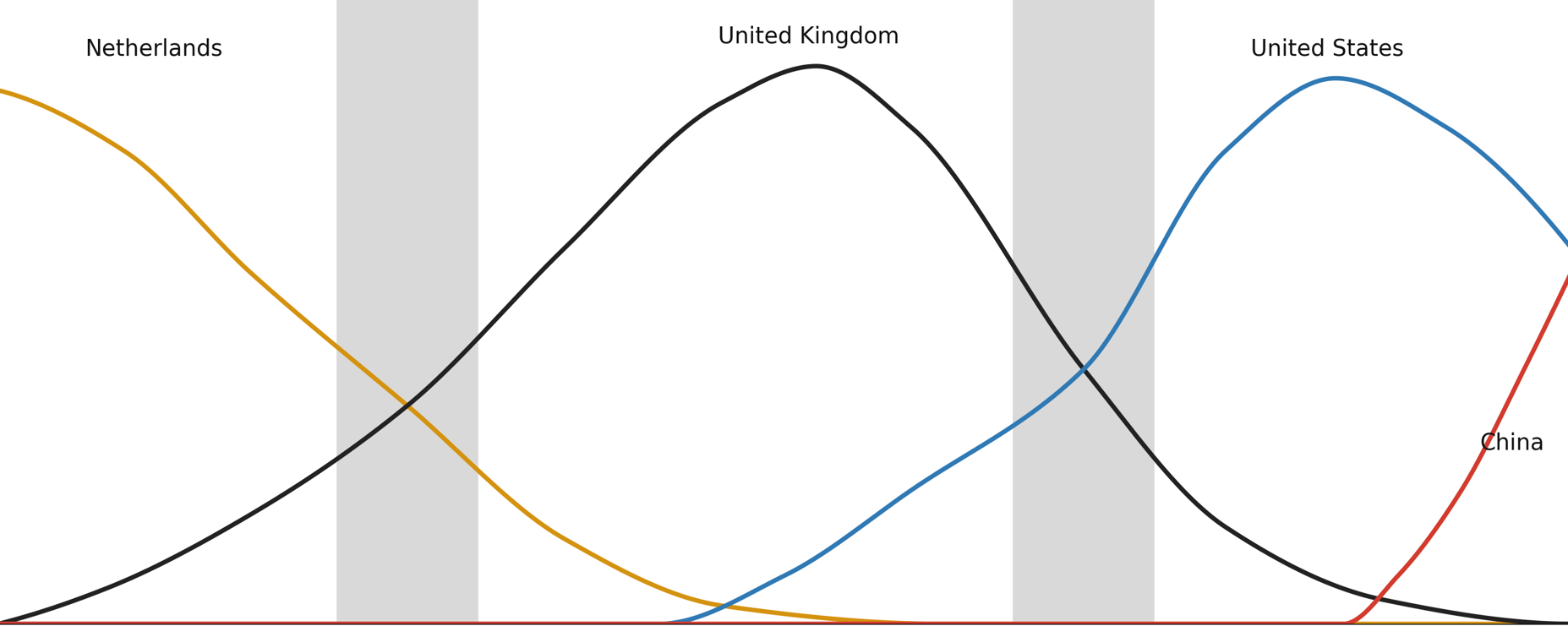
Britain used an almost identical version of it for the better part of two centuries, protecting its own textile and shipbuilding industries behind tariff walls until they could out-compete anyone on Earth.
And then, in 1846, at the very peak of its industrial dominance, Britain did something that looks bizarre in hindsight: it abolished its own protections.
The Corn Laws fell.
Free trade became the gospel Britain preached to the entire world.
Put yourself in the position of every other nation watching that sermon.
The country that had just spent two centuries building an industrial fortress behind tariff walls was now telling everyone else that walls were immoral — after it no longer needed them.
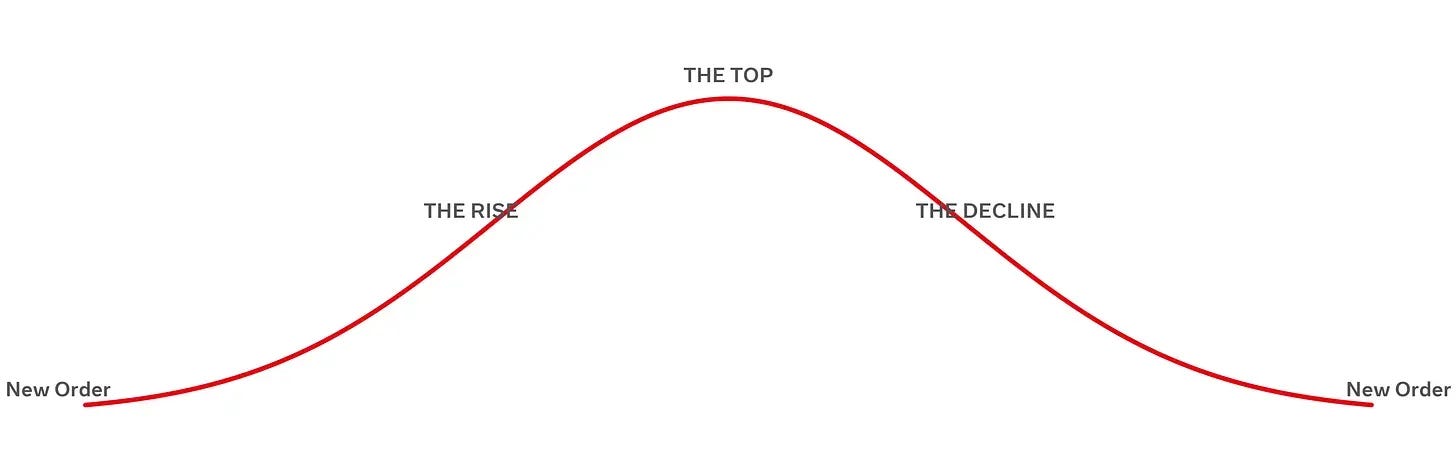
Predictably, British industry began a slow migration abroad. Manufacturing dispersed. Britain’s relative dominance eroded, gradually and then, by the time of two world wars, catastrophically.
By 1945 the torch had passed fully to the United States.
The decline had taken eighty-five years — too slow to make headlines while it was happening, but it happened all the same.
Then America, having reached the summit exactly as Britain once had, did precisely what Britain did.
It preached free trade globally. It opened its borders to capital and goods. And, over roughly four decades, it financialized its own economy — increasingly making money by trading pieces of paper rather than building things.
Why build a factory, at enormous capital cost and years of lead time, when you can buy back your own stock and watch the share price rise instead?
Why pay an American factory worker when a worker on the other side of the planet costs a fraction as much?
The consumer side of that bargain looks, on the surface, like an extraordinary deal.
Television prices have fallen roughly 98% since 2000.
Toy prices are down 74%.
But the things that can’t be shipped across an ocean in a container — the things tied to a specific place, delivered by a specific person, in a specific room — got dramatically more expensive over the same period.
Housing is up over 100%.
Childcare is up roughly 160%.
Hospital care is up close to 280%.
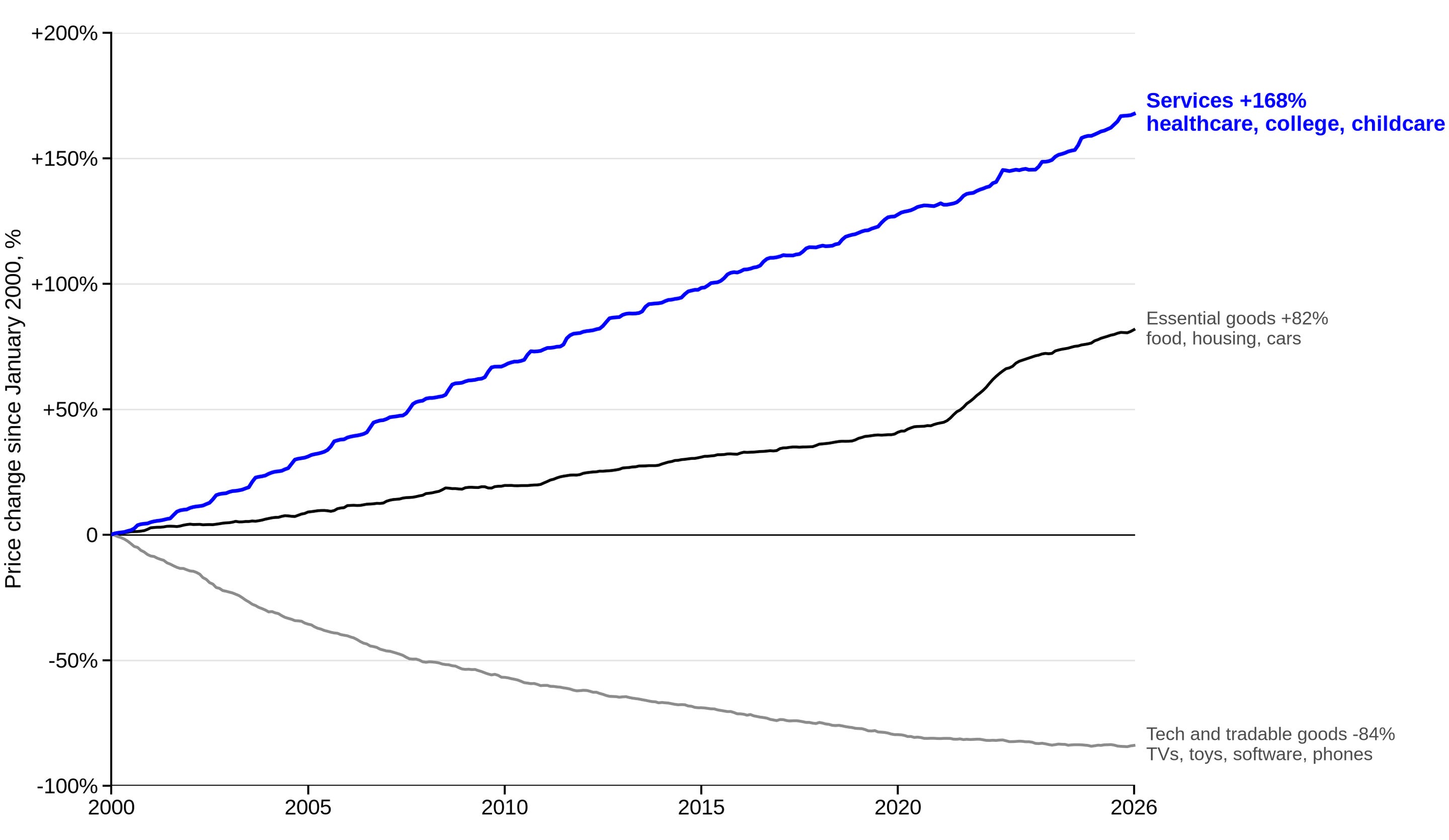
Cheap electronics, purchased with an increasingly unaffordable life. That was the trade America made, largely without realizing it was making it.
The bill has now arrived, and Washington wants to renegotiate it.
Join 1,000+ Investors Using the 80/20 Rule to Build Smarter, Higher-Returning Portfolios
The Pareto Investor delivers a proven, systematic framework to apply the 80/20 rule to stocks — focusing only on the tiny fraction of companies that drive nearly all market gains.
Membership Tiers for 2026:
Premium — Everything you need to outperform the market with less effort:
Full access to all live Pareto portfolios (Growth, Dividend & Permanent)
Monthly portfolio updates with exact stock selections
Rebalancing alerts & detailed review framework
Exclusive investment insights & advanced portfolio optimizations
Elite — Everything in Premium & permanent ownership of my most powerful tools:
Pareto Elite Sheet — Fully automated annual rebalancing, real-time portfolio dashboard, and live tracking.
50+ Years of Historical Stock Data.
Pareto Watchlist & AI Stock Screener.
EXCLUSIVE All-Weather Portfolio — Immediate, exclusive access to my stock-based portfolio built to hold up in every market. Available only to Elite members.
Only 4% of stocks account for nearly all net wealth creation in the market. Why settle for mediocre index returns held back by thousands of underperformers? Join 1,000+ investors focusing only on the rare winners — and upgrade your returns with the Pareto Principle today.
An Impossible Triangle
This is where Bessent’s op-ed and Greer’s Davos remarks stop being political rhetoric and start being an investable macro thesis — because what they’re describing runs directly into a mathematical wall.
America wants three things: factories back, the middle class able to afford things, and a strong dollar running the world.
You can only have two. You cannot have all three simultaneously.
Walk through the three doors:
Keep a strong dollar and protect purchasing power.
American factories stay too expensive to compete with cheaper labor abroad. A strong dollar makes imports cheap and American-made goods expensive. Reshoring doesn’t happen. This was the last 50 years.Rebuild factories and protect purchasing power.
To make American goods competitive again, the dollar has to get meaningfully weaker. But a weaker dollar erodes its status as the world’s reserve currency, and makes it much harder for America to finance its deficits cheaply.Rebuild factories and keep a strong dollar.
The only tool left is massive tariffs. And tariffs are paid by the American consumer at the checkout, on almost everything. Inflation rises to cover the cost of bringing factories back, which destroys the purchasing power you were trying to protect. And it doesn’t stay in America, a strong dollar plus tariff-driven disruption in commodities pushes prices up in Europe too.
No fourth door!
Washington understands this trap perfectly.
Which is why the dollar itself will likely be the shock absorber — not a chaotic collapse against other currencies, but a carefully managed move lower.
That leaves one question:
“If the dollar gives, what takes its place as the world's trusted reserve? It can't be another government's money.”
Whatever absorbs the strain needs to satisfy conditions no national currency can meet: it can’t belong to any single government that could debase it at will, it needs universal acceptance without negotiation, and it needs a multi-century track record deep enough that trust in it doesn’t require trusting any government at all.
Cross national fiat currencies off the list — they all belong to somebody.
Only one asset passes.
Gold.