

Dear investors,
If you’ve been watching the screens lately, you know the feeling.
The memory supercycle is in full swing, and retail money is blindly chasing hardware hype to all-time highs on the heels of a historic spin-off.
It’s a spectacular run. But chasing a crowded momentum trade after it has already gone vertical is a classic trap.
Electrons are the new memory!
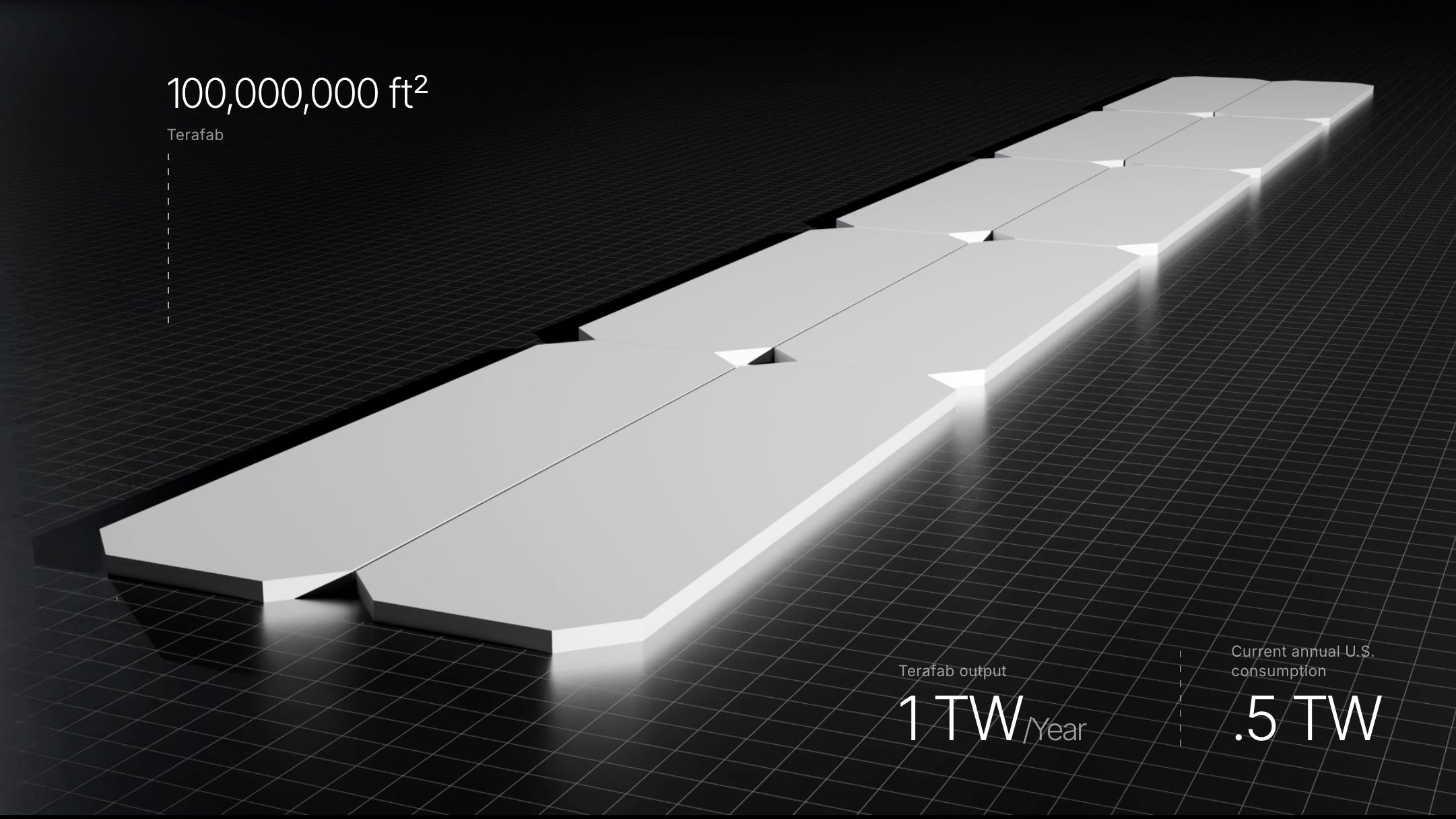
Elon Musk’s Terafab project — the joint Tesla/SpaceX/xAI venture designed to produce one terawatt of AI compute capacity annually — numbers are hard to believe.
Even the central-case scenario, not the extreme one, requires electrical capacity roughly equal to the entire United States grid.
For a single company’s compute roadmap!
Whether Terafab ultimately lands at twenty five percent of that projection or scales to its full ambition, the trajectory is unambiguous: private capital is now chasing AI infrastructure at a magnitude the existing power grid was never engineered to support.
To understand why this changes everything, you have to look past the headlines and into the math.
Terafab’s planned footprint: ~100,000,000 sq ft (3 Central Parks)
Terafab’s targeted continuous output: 1 TW
Current U.S. average continuous power consumption: ~0.5 TW
if Terafab reaches its stated target: ~2x current U.S. power consumption, from one project
By 2030, the Terafab initiative alone is projected to consume up to 1 terawatt (1,000 gigawatts) of continuous power—more than the entire United States grid uses today.
Musk set an extremely ambitious long-term goal:
“Build or secure 1 terawatt (1,000 GW) of dedicated power capacity to achieve true artificial general intelligence.”
If Terafab achieved this capacity today, it would consume more electricity than the entire United States, dwarfing the national grids of France, South Korea, Brazil, and Saudi Arabia combined.
And xAI isn’t alone in this power-hungry race.
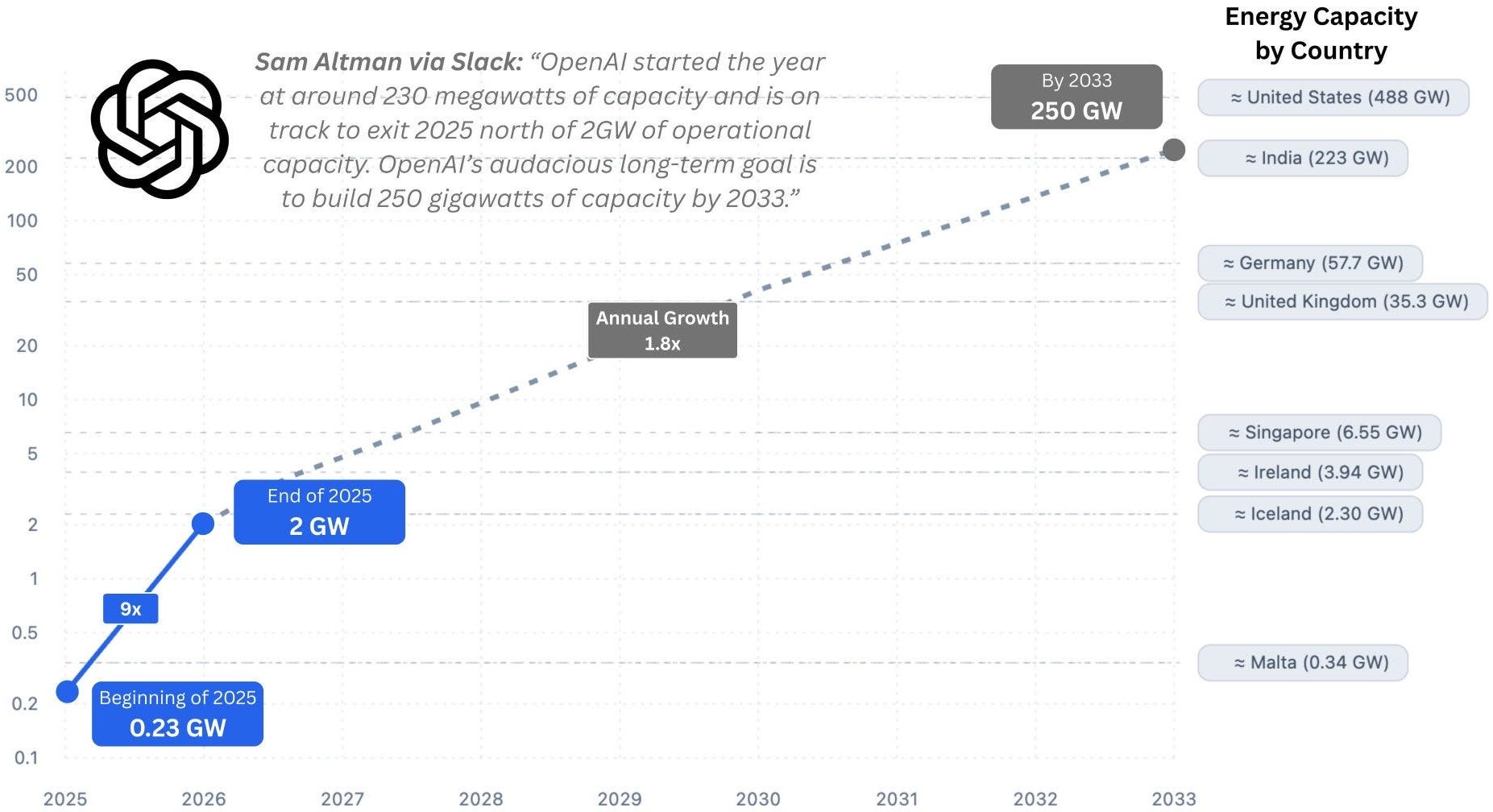
How much power is 1,000 GW really?
1,000 GW = 1,000,000 megawatts (MW) = 1,000,000,000 kilowatts (kW)
For comparison:
The largest nuclear power plant in the U.S. (Palo Verde) produces ~4 GW.
The entire United Kingdom’s average electricity demand is ~30–35 GW.
All of Google’s global data centers combined use roughly 15–20 GW.
Terafab alone wants the equivalent of 30 entire United Kingdoms’ worth of electricity, or roughly 100% of the entire United States’ total generating capacity, dedicated only to its AI clusters.
To manage this, xAI would need to buy hundreds of millions of high-end GPUs every single year and run them 24/7/365.
Rough math:
Assume future GPUs in 2030 are 5–10× more power-efficient than 2025 H100s but models are 100–1000× bigger → net ~50–200× more total compute needed.
1,000 GW of power ÷ ~800 W per future GPU ≈ 1.25 billion GPUs running simultaneously.
GPUs used for training burn out or become obsolete fast when run flat-out (typical lifetime 2–4 years in AI training).
So every year you have to replace ~1/4 of them → 300+ million replacements + growth → easily 300–400 million new GPUs purchased per year.
Nvidia’s entire production of H100/H200/B100/B200 GPUs in 2024–2025 is estimated at only ~3–5 million units total worldwide.
So, Terafab alone would need 80–100× Nvidia’s entire current output every year!
And here’s the kicker: xAI will likely be just one of a dozen companies requiring that much power.
Analysts estimate it costs approximately $50 billion to establish one gigawatt of computing capacity, accounting for hardware, energy infrastructure, and data center development.
Based on Musk’s 1,000 GW (1 Terawatt) target, the implied cost would reach a staggering $50 trillion!
Industry analysts estimate that even with xAI’s massive valuation and Tesla’s cash flows, the revenue required to justify a $50 trillion infrastructure buildout is astronomical.
This financing gap suggests that energy infrastructure investments may need to come from utilities, governments, and ultimately ratepayers rather than the AI companies themselves.
Artificial intelligence boom is creating an unprecedented demand shock for electricity.
Data centers consumed approximately 415 terawatt-hours globally in 2024, representing about 1.5% of total global electricity demand.
By 2030, that figure is projected to more than double to 945 terawatt-hours—roughly equivalent to Japan’s entire electricity consumption.
Memory was the first hardware bottleneck of the AI boom, the next one is physical, and I show who profits when robots leave the lab in Humanoid Robots Are Coming.
Grid Can’t Handle What’s Coming
In the U.S. specifically, the growth trajectory is even more dramatic.
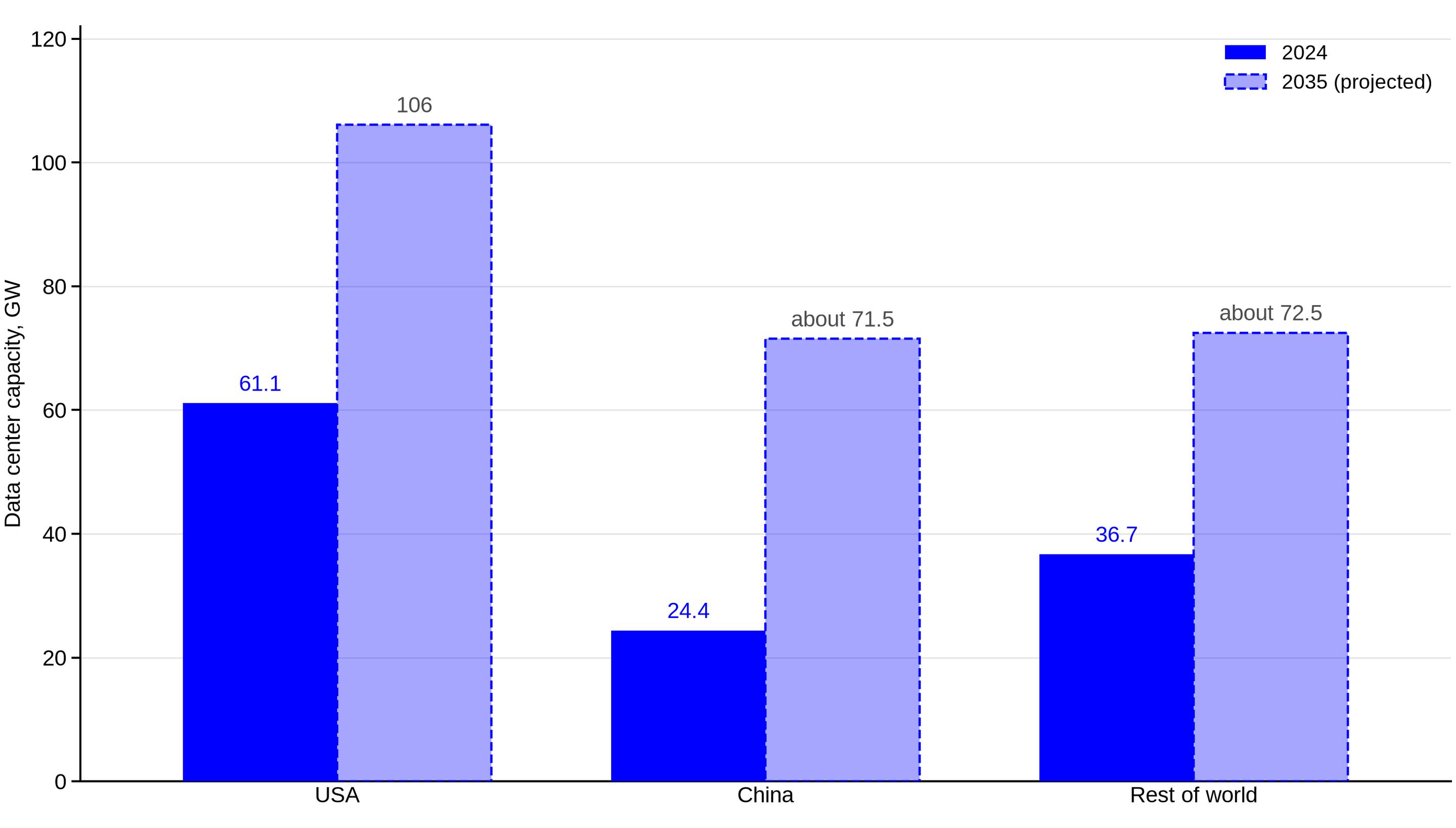
The U.S. grid currently operates at 62 gigawatts of data center capacity.
By 2030, 170 gigawatts is needed.
That’s 108 gigawatts of new capacity.
In five years!
Even the conservative case requires building capacity equal to South Korea’s entire grid. The aggressive case requires building Germany’s entire grid—just for AI.
During a labor shortage. With 10-15 year nuclear plant construction timelines.
Goldman Sachs calls this,
“the most constrained infrastructure bottleneck in modern history.”
On November 9, 2025, Goldman Sachs Research published their updated data center power demand forecast: a 175% surge by 2030 versus 2023 levels—the equivalent of adding electricity demand greater than the entire nation of France.
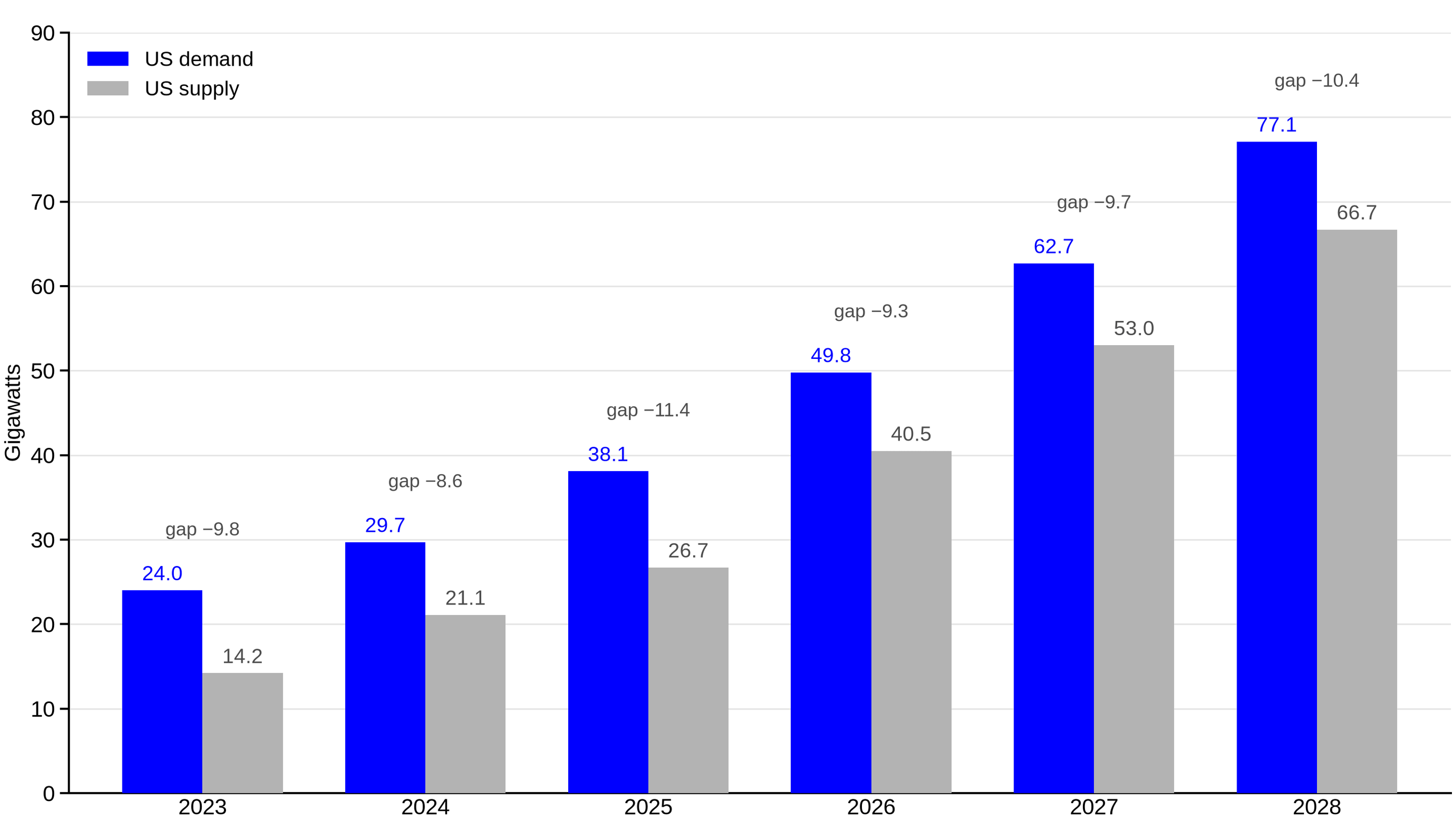
The electrical grid infrastructure in the United States was not designed for the explosive growth in data center demand that AI is driving.
Power shortages are already delaying data center projects by two to six years, creating a bottleneck that threatens the entire AI revolution.
This year alone, electricity demand from data centers in the U.S. is estimated to rise 22%. The challenge isn’t just about generating more electricity—it’s about delivering that power where it’s needed, when it’s needed, with the reliability that AI operations demand.
Large AI data centers can require dramatically more energy per square foot than traditional data centers.
A five-acre data center augmenting central processing units with specialized graphics processing units might see its energy usage increase from 5 to 50 megawatts—a tenfold increase.
The hyperscalers—the leading AI infrastructure developers scaling data center networks globally—are constructing facilities that dwarf anything previously built.
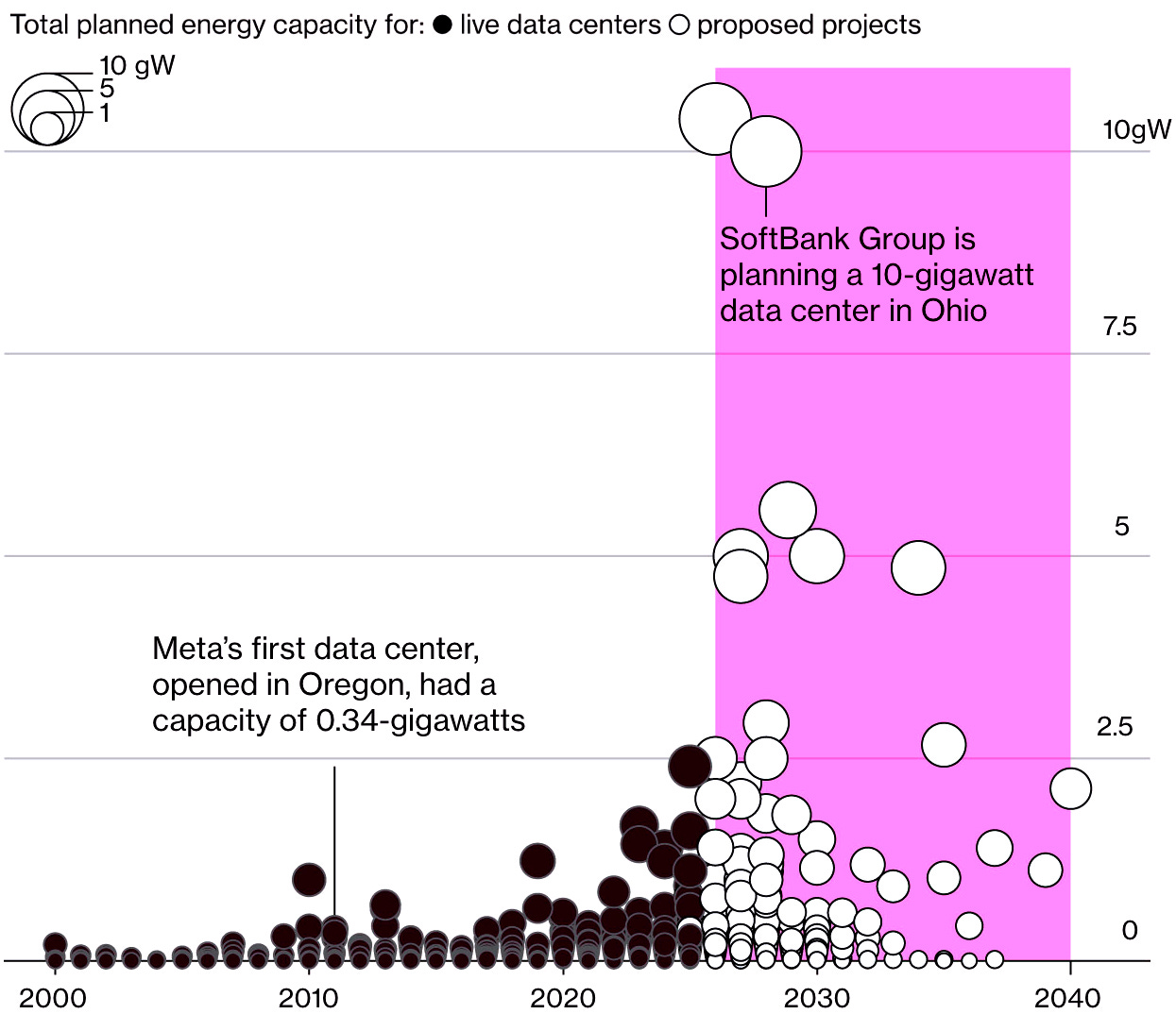
Each of the top three hyperscalers’ largest U.S. data centers currently draw less than 500 megawatts of power, but the largest data centers they are constructing or planning to build require between 1 and 2 gigawatts.
Some planned campus developments could consume 5 gigawatts or more, equivalent to the power needs of several medium-sized cities.
Join 1,000+ Investors Using the 80/20 Rule to Build Smarter, Higher-Returning Portfolios
The Pareto Investor delivers a proven, systematic framework to apply the 80/20 rule to stocks — focusing only on the tiny fraction of companies that drive nearly all market gains.
Membership Tiers for 2026:
Premium — Everything you need to outperform the market with less effort:
Full access to all live Pareto portfolios (Growth, Dividend & Permanent)
Monthly portfolio updates with exact stock selections
Rebalancing alerts & detailed review framework
Exclusive investment insights & advanced portfolio optimizations
Elite — Everything in Premium & permanent ownership of my most powerful tools:
Pareto Elite Sheet — Fully automated annual rebalancing, real-time portfolio dashboard, and live tracking.
50+ Years of Historical Stock Data.
Pareto Watchlist & AI Stock Screener.
EXCLUSIVE All-Weather Portfolio — Immediate, exclusive access to my stock-based portfolio built to hold up in every market. Available only to Elite members.
Only 4% of stocks account for nearly all net wealth creation in the market. Why settle for mediocre index returns held back by thousands of underperformers? Join 1,000+ investors focusing only on the rare winners — and upgrade your returns with the Pareto Principle today.
Capex Explosion
Generative AI — the ChatGPT-style models everyone got used to over the last few years — operates in bursts.
A prompt comes in, the model answers, the compute cycle ends. Agentic AI doesn’t behave that way. An AI agent reasons through multi-step problems, plans across long time horizons, coordinates with other agents, and runs continuously — 24 hours a day, 365 days a year, with no idle state.
Jensen Huang has put a number on the gap: the shift from generative to agentic workloads could require up to 1,000 times more power capacity than today’s systems run on. Even if you discount that warning by an order of magnitude for hype, you’re still left with a demand curve that doesn’t bend gently upward. It goes vertical.
Training sophisticated AI models demands immense computing power—GPT-4 training alone required around 30 megawatts of power, while xAI’s Colossus and upcoming Terafab initiatives anticipate multi-gigawatt data centers.
A typical generative AI query uses approximately 10 times the energy of a standard Google search, fundamentally changing the economics of digital services.
By 2035, data centers are projected to account for 11.6% of all U.S. electricity demand, more than triple their 3.5% share today.
This massive supply-demand imbalance creates an investment opportunity that transcends traditional utility sector dynamics. Goldman Sachs Research now projects the top five hyperscalers—Amazon, Microsoft, Google, Meta, and Oracle—will spend $736 billion in combined capital expenditures in 2025 alone, with 60-70% earmarked for data center and power infrastructure.
That’s $442 billion flowing into power infrastructure in a single year—more than the entire U.S. renewable energy sector invested over the past decade.
Translation:
The AI revolution has moved from a software problem to a physics problem.
Today, the hyperscalers have quietly flipped the switch.
They’re no longer in “cost-optimization” mode when it comes to power.
They’re in full-blown survival mode. Microsoft, Google, Amazon, Meta, Oracle, xAI, OpenAI, and Tesla are now racing to lock in guaranteed, always-on electricity at almost any price — because the first ones to secure gigawatts of reliable baseload power will enjoy an unassailable, decade-long moat over everyone else. In the AI arms race, megawatts have become the new oil.
The companies that own (or control) them don’t just win — they render latecomers mathematically incapable of catching up. Power is becoming the ultimate barrier to entry!
Goldman Sachs Research documents the scale: $600-725 billion in 2026 capex from major hyperscalers, with an estimated $450 billion dedicated specifically to AI infrastructure and power-related spending.
This represents a 300%+ increase in power-related spending versus 2023 levels. Let that sink in: Tech companies are spending more on electricity infrastructure than semiconductors!
The deals prove desperation has replaced optimization:
Amazon (AWS):
Over $20 billion investment for nuclear-powered data center campus
1.9 GW from Talen Energy nuclear plant through 2042, paying premium rates
Total nuclear portfolio exceeds 3 GW with additional SMR deals
Microsoft:
10.5 GW Brookfield deal (nuclear & solar) — largest corporate clean energy deal ever
Three Mile Island nuclear restart PPA for 835 MW
$26.85 million for 1,350-acre North Carolina site near Duke Energy nuclear facilities
Meta:
6.6 GW nuclear deals announced January 2026 with Vistra (2.6 GW), Oklo, and TerraPower
Multi-gigawatt agreements in Texas and Louisiana with take-or-pay provisions
200 MW modular gas turbines for tent-based data centers
Google:
$3+ billion in power commitments for Ohio, Indiana, and Virginia data centers
1 GW solar PPA with TotalEnergies
Multiple new generation capacity deals requiring dedicated infrastructure
Oracle:
$40-50 billion AI infrastructure investment planned for 2026
10 GW of power and data center capacity secured through partners
4.5 GW Stargate partnership with OpenAI
$300 billion cloud computing deal with OpenAI over multiple years
xAI:
Buying entire overseas power plant to ship to the US
2 GW for million-GPU data center in Mississippi
$20 billion data center investment with modular gas turbines
OpenAI:
$300-500 billion Stargate project with Oracle and SoftBank
10 GW total planned capacity across multiple sites
4.5 GW additional data center expansion committed
7 GW combined power draw across five new Stargate sites
Tesla:
$20 billion CapEx projected for 2026 AI infrastructure
Six major AI data center facilities planned
US data center power demand is projected to surge from 31 GW (2025) to 41 GW (2026) to 66 GW (2027) — more than doubling in just two years.
Power purchase agreements now range from $75-120/MWh for nuclear, with hyperscalers accepting 20-40% premiums over market rates to secure guaranteed baseload capacity.
The AI infrastructure arms race isn’t coming — it’s already here, and the winners will be those who control the electrons.
When companies worth $8+ trillion combined are paying 40% premiums and offering guaranteed payment for unused electricity, that’s not normal corporate behavior. That’s existential panic.
The scenario is materializing in Northern Virginia—the world’s largest data center market with 13% of global operational capacity.
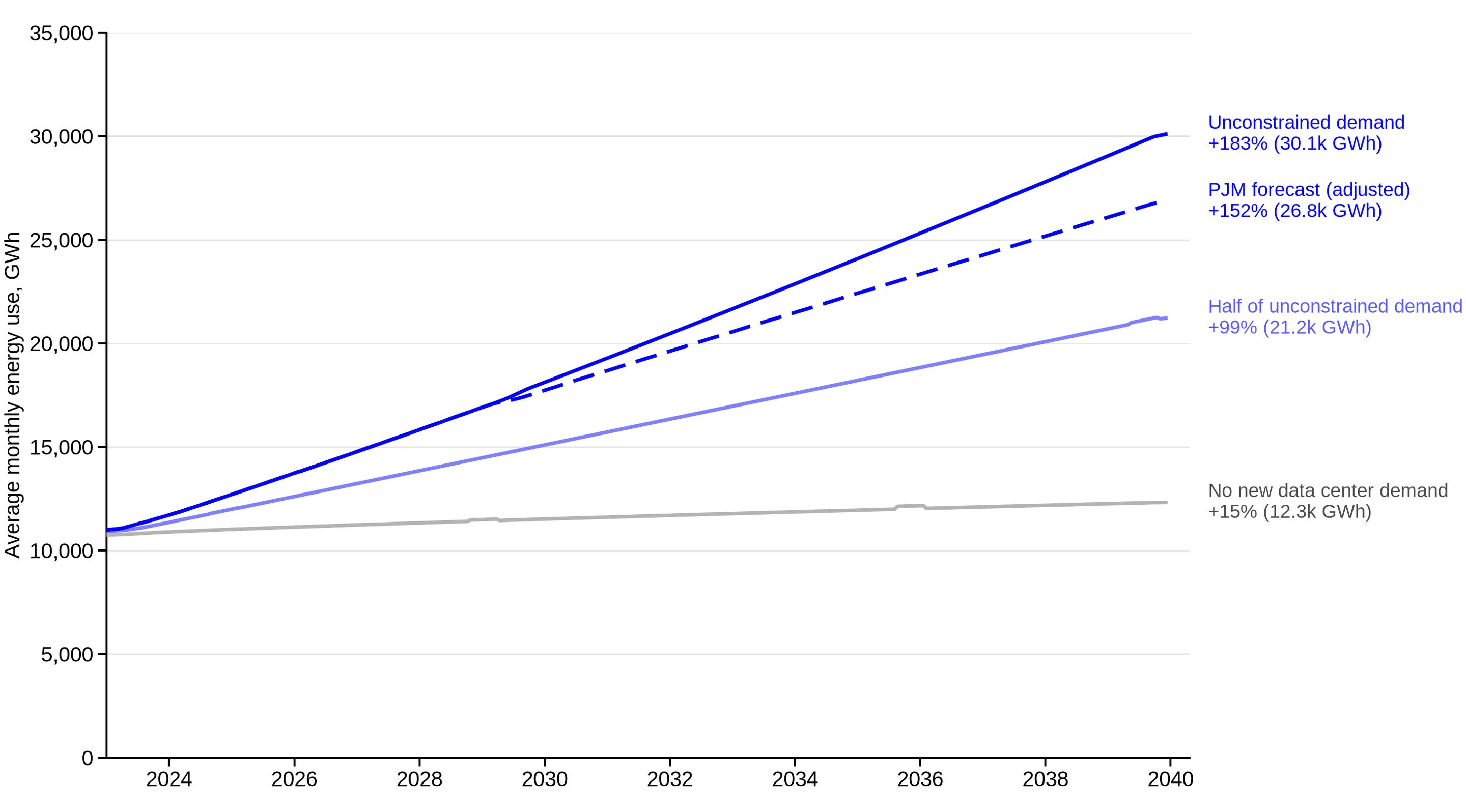
Virginia’s power grid cannot support current data center commitments without unprecedented infrastructure investment.
The report’s conclusion is devastating:
“The sustained scale and pace of data center growth in the region will likely be constrained by new energy infrastructure development.
Grid interconnection policies will delay new load from connecting until the infrastructure to serve it reliably is in place.
These policies will constrain data center load growth to the rate of infrastructure expansion.
Building enough infrastructure for data center demand will be very difficult and meeting half that demand is still difficult.”
Data centers already approved and funded may never turn on because the electricity doesn’t exist. What happens when this bottleneck hits every major market simultaneously?