

Dear investors,
August was the month Treasury blinked - not the Fed.
Pareto Portfolios Performance, August 24, 2026:
Pareto Growth Portfolio: +16.4% YTD
Pareto Dividend Portfolio: +22.9% YTD
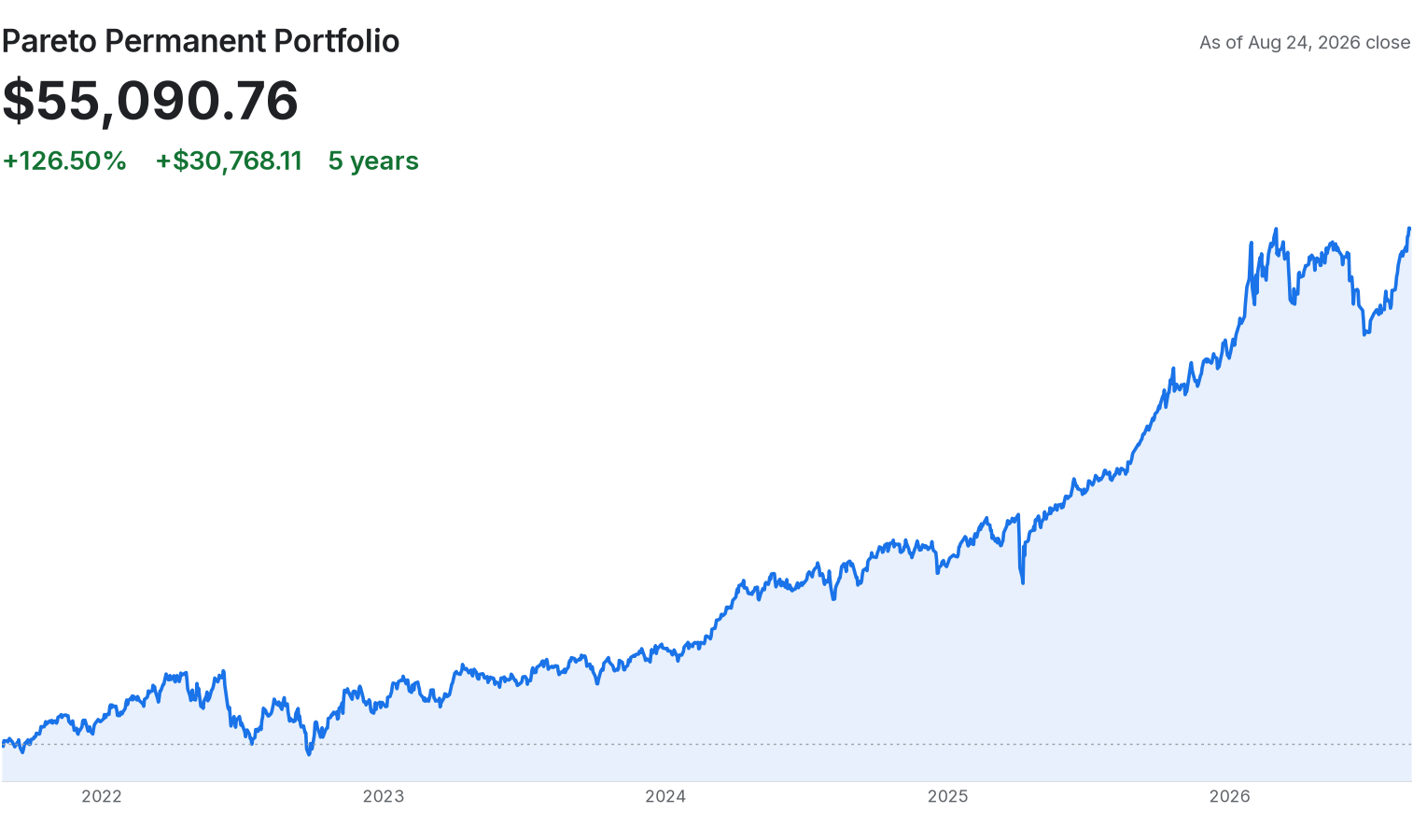
Pareto Permanent Portfolio: +6.3% YTD
Pareto Portfolios remains ahead of the S&P 500 (+11% YTD) by 5.4 percentage points year to date.
For the first time in this cycle, the marginal buyer of long-duration risk was not Powell, but Bessent. The implications for equities, the 60/40 portfolio, and for real assets were immediate.
This update covers what happened, why it is structural, and how the Pareto portfolios were repositioned.
What we witnessed in early August was a repricing of sovereign risk.
A sharp sell-off in 10-year and 30-year bonds that pushed US borrowing costs to multi-decade highs. The catalyst was simple arithmetic: the Treasury market is $32 trillion, the federal debt pile just hit a record $40 trillion, and the single largest incremental buyer of long duration this year has not been pensions or foreign reserves - it has been AI capex.
At 5.34% on the 30-year, that funding becomes 2x more expensive.
The bond market was forcing a choice: either Fed rates are too high for the next 2-3 years, or if the Fed holds, long rates surge and shut the AI funding window.
This is not a Fed policy story. It is a fiscal dominance story and for the second time this month Bessent has acted as a market participant, not just a policymaker, after joining Japan in an August 1 intervention to stem the yen’s slide to 40-year lows.
If you want to follow along with real money, here's how to copy my portfolio in 5 minutes.
Evercore ISI summarized the tactic:
“Bessent is again showing his tactical skill as an activist Treasury secretary — hitting bond shorts with a surprise announcement of an August day with thin liquidity and a lull in prior one-way bets on yields higher.”
As I flagged in July, a rotation out of AI names and into steadier, cash-generative businesses looked increasingly likely.
It arrived.
Roundhill Memory ETF ($DRAM) is now down >20% from recent highs - a technical bear market - despite Micron, SK Hynix and Samsung still posting ∼1,800% YoY profit growth.
The hardware layer hasn’t deteriorated. The market is digesting a sharp run-up.
For a systematic allocator, a 20% drawdown in a sector with that earnings power is an entry window, not a top. But capital is rotating nonetheless - into energy, healthcare, financials, and materials - businesses with durable cash flows and reasonable multiples.
That is exactly what the Pareto portfolios are built to capture.